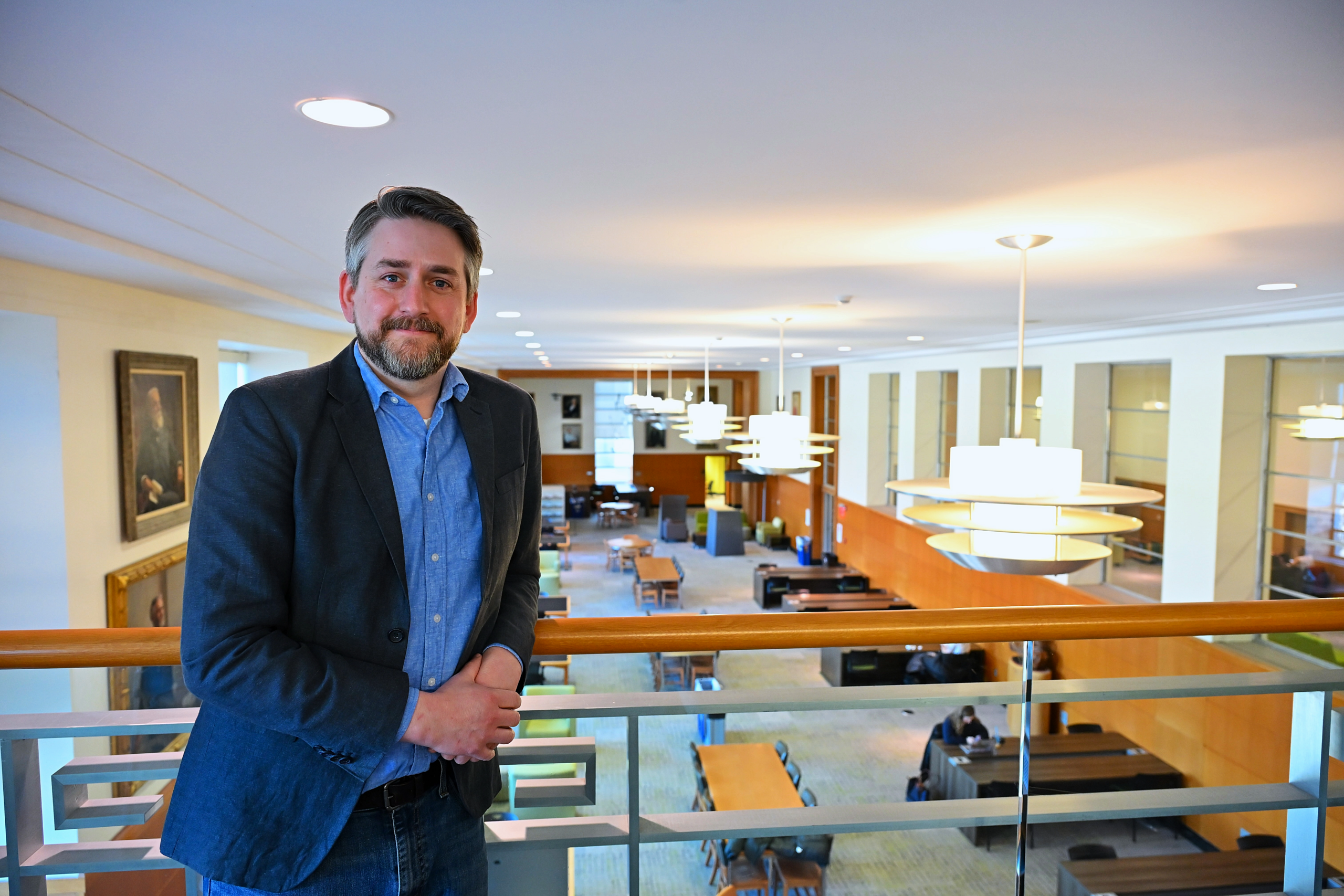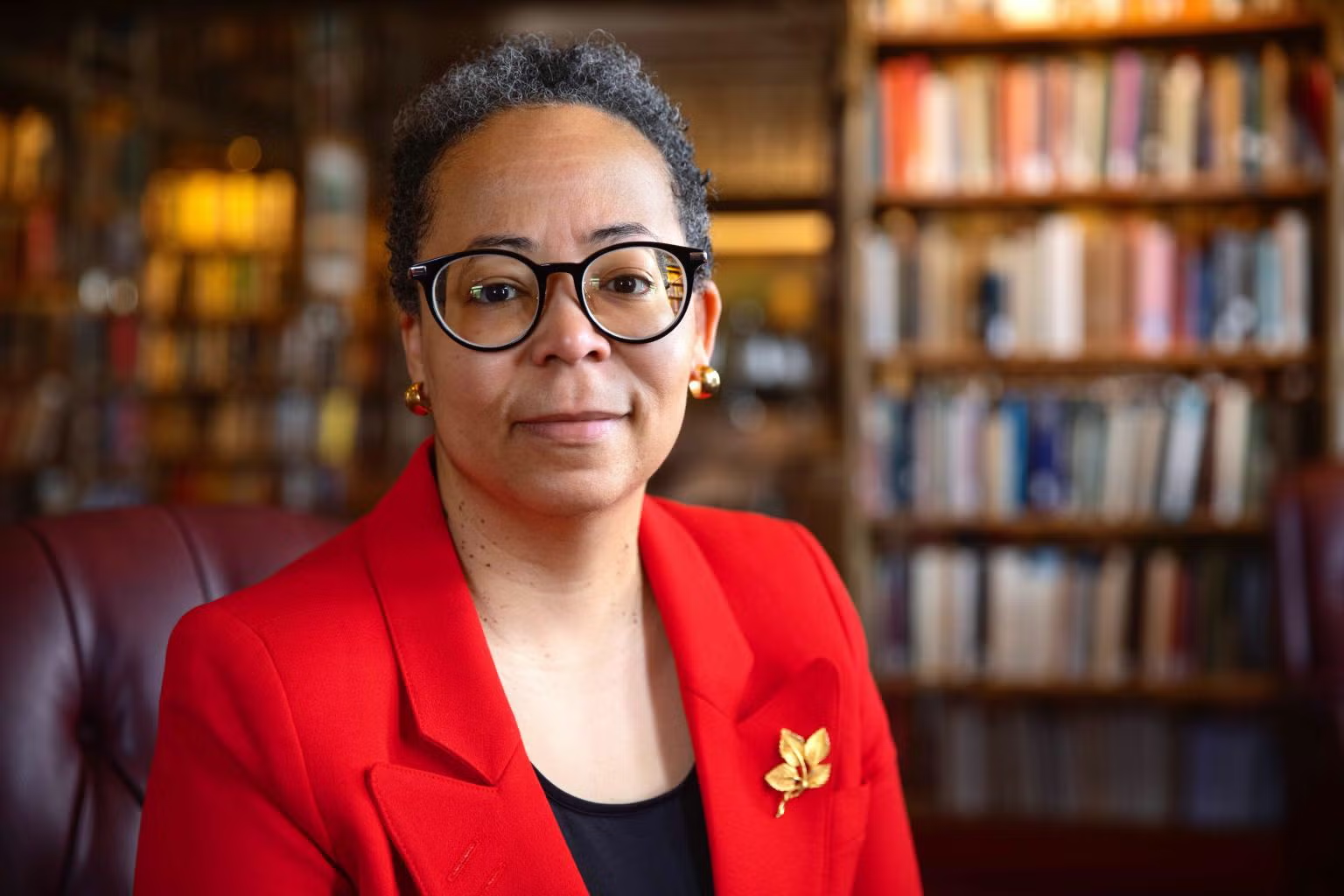
Elaine L. Westbrooks, the Carl A. Kroch University Librarian and Vice Provost at Cornell University, was a featured speaker for the Dean’s Spotlight Series of the School of Computing and Information at the University of Pittsburgh, which highlights industry and academic experts in the fields of computing, library, and information sciences. This year’s series focuses on how artificial intelligence (AI) intersects with various fields and careers, and explores the pros and cons of this emerging technology.
Westbrook delivered her talk on Oct. 16 on “Scientific publishing and the scholarly communication ecosystem in the Age of AI.”
“We already see that the most basic questions that we used to address at the reference desk are no longer asked because of Google and AI,” Westbrooks said, noting how AI is transforming library and information sciences. “Library hours, location of books—are no longer asked. On the flip side, the questions that do come through are far more complex and require subject expertise to appropriately answer.”
Westbrooks emphasized that while she does not consider herself an expert in AI, she recognizes that as an evolving tool, research libraries should be conscious of smart uses of AI, utilizing it to make better business decisions such as what books are more likely to circulate, how to spend limited resources, and how to eliminate simple mundane tasks so that librarians and staff are free to do more complex work.
“I’m not an AI boomer nor an AI doomer. It’s important to see the good and bad that comes with AI,” said Westbrooks. “The genie has left the bottle and it is never going back, so we need to find a way to use AI responsibly and effectively.”
When discussing the nuances and changes to the world of academic publishing, Westbrooks noted how that ecosystem has always had its pros and cons. For Westbrooks, the introduction of AI into this system has one major benefit.
“AI can help researchers save time on repetitive and simple tasks such as creating spreadsheets or outlines. AI can facilitate, but most publishers do not approve of AI being the sole author of a research article. Most publishers are using AI to check data and images for the sake of research integrity. The challenge is that there is a tool being created every day in this arena and it’s hard to keep up with all of them,” Westbrooks said.
Yet for all AI can do, one flaw Westbrooks noted the potential for misinformation and unethical use. Generating fraudulent images, data, and results can be more easily done with AI, and Westbrooks has observed an increase in fake research papers.
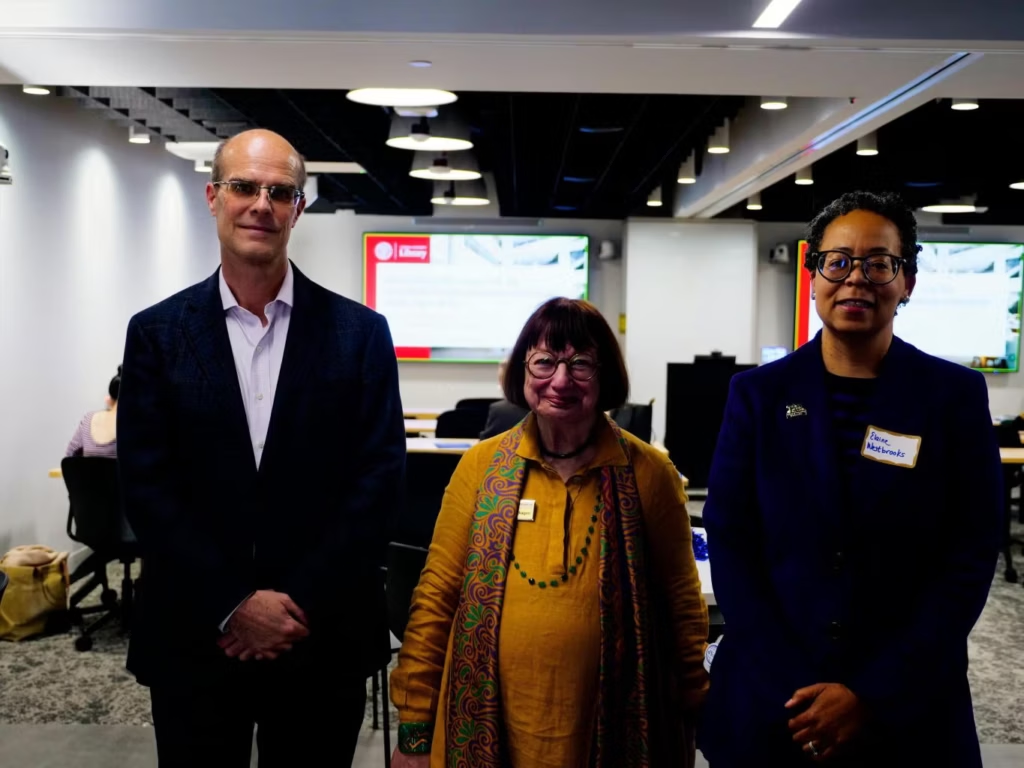
This publishing ecosystem includes more than research libraries, publishers, and researchers. University presses, learned societies, funders, archives, and any group of people dedicated to knowledge creation are part of the process as well.
“Technology is one of the biggest forces that has changed academic publishing. Additionally, changes in federal funding, pressures to publish for tenure, and open access options have also shaped academic publishing,” Westbrooks said.
Additionally, with higher education institutions reviewing changing financial situations, Westbrooks believes that both academic departments and broader societies must redefine what quality academic publishing looks like and what is important for earning tenure.
Ultimately, Westbrooks views the library and information sciences and academic publishing as two avenues for establishing and building communities.
“In order for scholarly publishing to persist, libraries, publishers, and researchers must be engaging each other—informally and formally. So there are connections but they could be stronger. Academic publishing is far more complex and complicated than most would think,” she said. Accessibility, openness, and information sharing are at the heart of library sciences, Westbrooks emphasized, especially without commercial motivations.
“On most campuses, the library plays a key educational role in helping researchers understand open access, public access policies, data management planning, or how to deposit an article in a repository,” Westbrooks said.
As for how AI is changing education and information, Westbrooks notes that adapting to new tech and developing literacies to get better results is something those in the library sciences have been doing for decades.
“In reality, information chooses us. I firmly believe that libraries, who have been information literacy champions are now going to be the AI literacy champions,” she said. “AI is the latest literacy to emerge but librarians have also been delivering literacies to help students better understand and use media, digital information, primary resources, algorithms, and social media.”
Despite broader shifts in higher education, Westbrooks is still excited by her chosen career, which began when she was a linguistics student at the University of Pittsburgh.
“I love helping people,” she said. “On the first day of class when I was a freshman, I got a job at the library and I have never left. I worked in nearly every department as a student and I learned so much. I got to work with amazing people. Working at the library made me a better student. I loved being a citizen of the university. As a librarian I could do research, I can help others do research, I can also impact the profession – I found all of these options to be really attractive and fulfilling.”
Westbrooks’s faith in the mission of libraries and library sciences was consistent throughout her talk.
“Librarians are such an important part of the system because we help preserve human knowledge, we help people find information, and we archive information for future generations,” she said. “Having evidence that documents our complex cultures and histories is essential for us to understand our past to make sense of today to build a better future. Libraries are the cornerstone of democracy. Libraries are trusted and essential to helping students belong, find community, and learn.”
For anyone new to the world of research publication or unfamiliar with the library sciences, Westbrooks has some advice: “Follow your passion and create new knowledge. We must always try to understand what it means to be human. We need to find ways to alleviate suffering, to solve grand problems, and to inspire and be inspired.”
This news story was adapted from the website of the School of Computing and Information at the University of Pittsburgh.