After a successful pilot launch in the spring, Cornell’s AI Critical Literacy Program will be offered in the fall to all incoming students as well as other interested students, faculty members and staff.
The expanded program will feature four modules—“What is Generative AI?”; “Ethical Questions Surrounding Generative AI”; “GenAI and Learning”; and “Creating an AI Policy for Personal Use”—via the web-based learning platform Canvas.
The pilot program resulted in measurable gains in literacy, especially in how AI tools work, how large language models are developed and what they do, said Rob Vanderlan, executive director of the Center for Teaching Innovation (CTI), which developed the program with Cornell University Library.
“We received a lot of positive feedback from students on how much they learned about a number of ethical issues they hadn’t been aware of before,” Vanderlan said. “We also saw some really good evidence of students reflecting on their own behaviors and use of AI to benefit their learning.”
The expanded program incorporates recommendations from faculty across campus who tested the pilot program in mostly undergraduate courses ranging from first-year writing to business, biology, engineering, economics, communications and information science.
The material is designed to engage students and faculty from different fields and with varying levels of experience, said Christina Sheley, associate university librarian for research, teaching and engagement at Cornell University Library. Faculty members are invited to adapt and integrate the program’s content into their first-year classes and advising seminars, she said.
“There is a spectrum of how AI is being used, comfort levels and how personal values and ethics are shaping behavior, so we hope to address those aspects,” Sheley said. “The program is focused on general AI literacy while being attuned to students and faculty.”
Pilot participant Andrea Stevenson Won, associate professor of communication in the College of Agriculture and Life Sciences (CALS), said she is hopeful the expanded program will spark much-needed dialogue on campus about AI.
“The program is about helping students decide whether their use of AI is actually contributing to their learning or not,” she said, “but it’s also designed to be built into classes as a way to foster these conversations between faculty and students.”
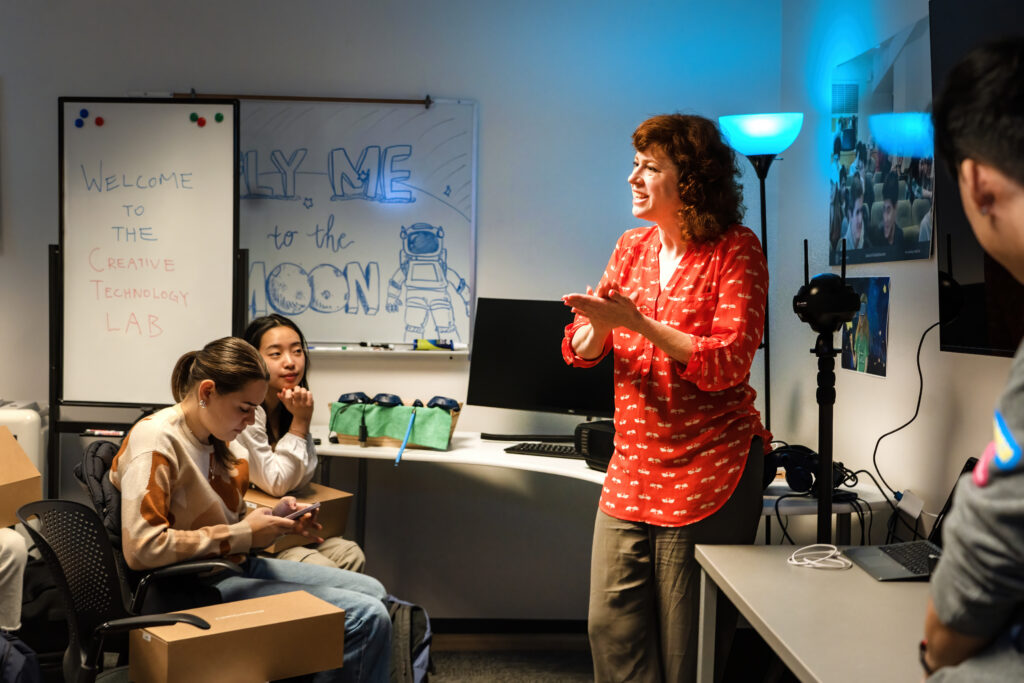
Won has a particular interest in the topic; she is a member of the Cornell GenAI Education Working Group and a scholar whose research interests include parasocial interactions between humans and AI agents.
“We’re going to have to keep considering how to integrate AI into classroom settings,” Won said, “as well as what sort of warnings and guardrails we might want to put in place not just for using it for teaching but also for using it in general.”
Another pilot participant, Mark Sarvary, senior lecturer in neurobiology and behavior in CALS and director of the Investigative Biology Teaching Laboratories, said teaching college students early about AI will go a long way toward helping them understand the ethical use of AI, how AI works and how people can use what AI produces.
“For example, many of our students in the biological sciences are pre-health students and will use AI in their professions,” he said. “These students need to become AI literate early in their academic careers, because literally, people’s lives will depend on it.”
This story also appeared in the Cornell Chronicle.