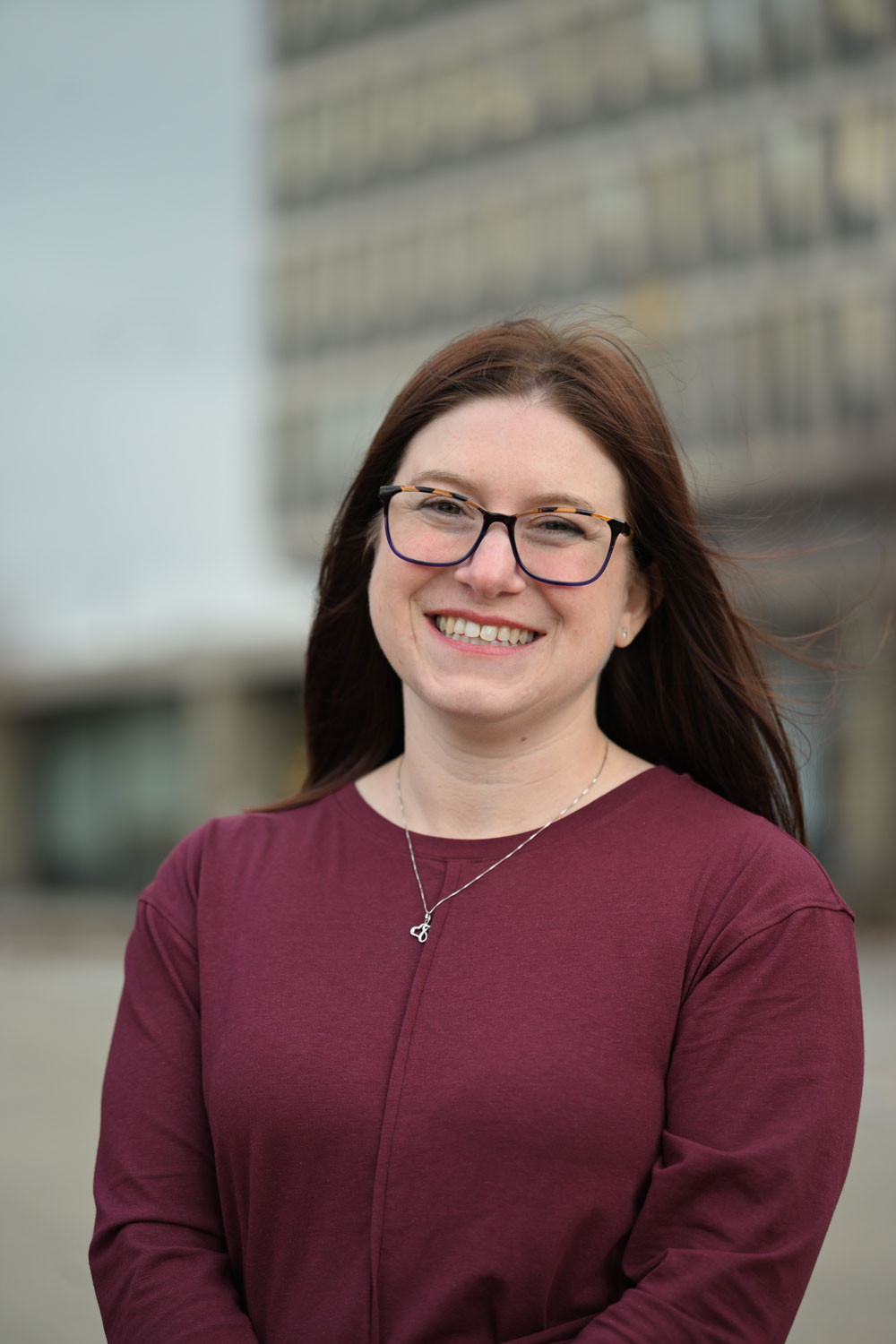
How do you study salary ranges and other employee statistics when private companies are tight-lipped about this information? Librarian Whitney Kramer knows a workaround: You look at comparable jobs in the public sector.
For the past couple of years, as a data librarian based in Cornell University Library’s Catherwood Library, Kramer has been helping students in John Hausknecht’s Human Resource Analytics class on how to gather, find, and interpret data sets as part of their research assignments.
“I first met with Professor Hausknecht to learn more about the learning outcomes for the class and the assignment, and what I suggested was that you could utilize publicly available government salary and hiring data as a proxy for the private company data because, as a general rule, you’re not going to be able to find private company data that students could work with,” Kramer said.
In addition to teaching research and data sessions for the class, Kramer has also created an online guide for the course.
“Whitney helped find sample data sets and put them on our course guide,” said Hausknecht, who is a professor of human resource studies at Cornell’s ILR School. “Students could kind of see the data structure and look at different variables and try to identify patterns and start to practice some of the data analysis tools and skills that we’re doing in the class.”
Hausknecht explained that data literacy is crucial for future industry leaders.
“Even with most complex analysis, data still doesn’t tell you what you should do as a manager or as an HR professional. So you have to build the data literacy and be able to understand the limitations of the data, and then use your good judgment to figure out what it means,” he said.
Data can be both eye-opening and fun for the students in the classroom and for those who drop in for one-on-one consultations with librarians, according to Kramer, who was recently appointed as the interim head of research and learning services for Cornell University Library’s Olin and Uris Libraries.
“The most rewarding thing for me is seeing the look of understanding on students’ faces when they realize that they’ve found the data set they’re looking for, or that they realize that working with data is not as intimidating as they thought it would be,” Kramer said.
How to get help with information and data from the library
Experts across Cornell University Library are ready to support your research data needs—from working with geospatial information to dealing with topics related to business and entrepreneurship; from publishing Open Access articles and data sets on eCommons to exploring different data storage options.
For general data inquiries, reach out to the library through Ask a Librarian, or by contacting your unit library. You can also find more info about the library’s Research Data and Open Scholarship department at their webpage.